








































































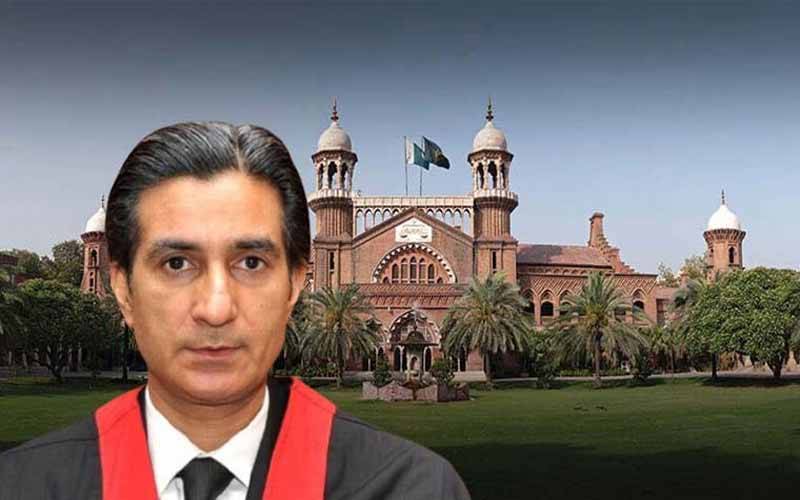
Justice Shams Mahmood Mirza of the Lahore High Court has tendered his resignation.
According to details, the wave of judicial resignations that began after the approval of the 27th Constitutional Amendment continues, and Justice Shams Mahmood Mirza has now also stepped down from his office. He formally submitted his resignation to President Asif Ali Zardari. A day earlier, during the hearing of a case, Justice Shams Mahmood Mirza had expressed serious concern over the reduction in judicial powers following the constitutional amendment, and today he proceeded to resign officially.
Before this, Justice Mansoor Ali Shah and Justice Athar Minallah of the Supreme Court had also resigned from their positions. Despite being the senior-most judge of the Supreme Court, Justice Mansoor Ali Shah was deprived of becoming the Chief Justice of Pakistan due to the 26th Amendment.
In his 13-page resignation letter, Justice Mansoor Ali Shah wrote that the 27th Constitutional Amendment is a grave assault on the Constitution of Pakistan and that it has effectively fractured the Supreme Court of Pakistan. He stated that he served the institution with dignity, honesty, and integrity; his conscience is clear, and he holds no regrets. However, as the senior-most judge, he was compelled to resign because the amendment has placed the judiciary under the control of the executive, striking at the very heart of constitutional democracy.
He further wrote that dividing the highest court of the country has damaged judicial independence and pushed the nation decades backward. At such a critical point, only two options remained, because the 27th Amendment has made justice inaccessible to ordinary citizens and rendered the weak powerless before authority.
Similarly, Supreme Court Justice Athar Minallah also resigned from his post. In the text of his resignation, he wrote that he took oath as a judge of the Islamabad High Court eleven years ago, later took oath as its Chief Justice, and four years after that, assumed office as a judge of the Supreme Court of Pakistan. Throughout this period, every oath he took was a solemn pledge to remain faithful to the Constitution — a commitment not to any individual or institution, but solely to the Constitution of Pakistan.
Justice Athar Minallah wrote that before the passage of the 27th Amendment, he had sent a letter to the then Chief Justice of Pakistan expressing constitutional concerns about the possible consequences of the amendment. However, the concerns that went unheard at the time have now become reality under an atmosphere of silence and inaction.
He stated that he always tried to fulfill his duties with the utmost honesty, but today that very oath obliges him to resign because the Constitution he vowed to protect no longer survives in its true form. He added that he cannot live under the illusion that the newly created structure stands upon the foundations of the Constitution; the truth is that the spirit of the Constitution has been struck down, and the framework being built now stands upon its remains.
Justice Athar Minallah wrote that the robe worn by judges is not an ordinary garment but a symbol of the sacred trust placed by the people in the judiciary. History shows that many times this robe became a symbol of silence and inaction. If future generations do not look at it differently, the future will mirror the same mistakes of the past. With the hope that future arbiters will uphold truth and justice, he concluded his letter by stating that he removes this robe for the last time and submits his resignation as a judge of the Supreme Court of Pakistan with immediate effect, praying that those who dispense justice do so with honesty and truth.