




































































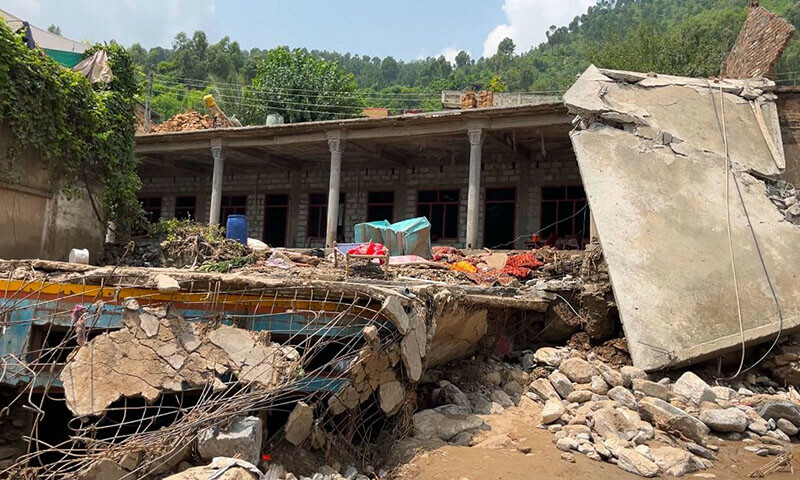
PESHAWAR: The education sector has been identified as the hardest hit by the recent torrential rains and flash floods in Khyber Pakhtunkhwa, with official data confirming the complete destruction of 61 government schools while another 414 have sustained varying degrees of damage.
Among the destroyed schools, 52 are primary, seven middle, and two high schools. The worst-affected district is Lower Dir, where 17 primary schools were demolished by floods, followed by Shangla where eight primary schools collapsed.
In Haripur, seven schools’ buildings were destroyed, including five primary, one middle, and one high school. Similarly, in Mohmand tribal district, eight primary and two middle schools were destroyed, while in Battagram four primary and one middle school were lost. Abbottabad reported four destroyed schools, including two primary, one middle, and one high, whereas Swat saw the destruction of two primary and one middle school.
The heavy rains and floods also partially damaged 414 schools across the province, including 319 primary, 36 middle, 43 high, and 16 higher secondary schools. Swat recorded the highest number of partially damaged schools with 122, followed by Abbottabad with 67, Shangla with 72, and Lower Dir with 69.
The official data also revealed tragic casualties: in Buner, four teachers and one non-teaching staff member were killed, while three other teachers were injured. Additionally, four students lost their lives due to the calamity.
Secretary of Elementary and Secondary Education Mohammad Khalid stated that the department is determined to ensure continuity of education for affected students. He said the government would establish pre-fabricated schools in affected areas, as these can be completed within one or two months. The department had earlier planned to set up 50 such schools across the province, but these will now be prioritized for flood-affected districts.
An education department official highlighted that the province’s education infrastructure is always heavily impacted in disasters due to schools being present in almost every village and neighborhood. He recalled that hundreds of schools were destroyed during the 2005 earthquake, many of which have still not been reconstructed due to inefficiency in rehabilitation authorities. The infrastructure was also severely hit during the war on terrorism, when dozens of schools were bombed, as well as during the 2010 floods.