













































Prices of more than one hundred commonly used medicines in Pakistan have risen on average by 32 percent since February last year. This upward trend began immediately after the caretaker government implemented its deregulation policy, under which all official restrictions on medicine pricing were completely withdrawn, allowing pharmaceutical companies to determine prices independently.
This development has triggered serious concern among government authorities, prompting the decision to formally seek clarification from the pharmaceutical industry about the reasons behind such a significant increase in medicine prices.
According to a report, the swift and unexpected surge in drug prices has not only intensified public anger but has also raised questions among policymakers. The government had initially anticipated that allowing market-based pricing would encourage competition and ultimately bring prices down for consumers. However, the outcome has been opposite, as prices continued to climb instead of decreasing.
These findings emerged through a preliminary national survey conducted on the instructions of the Prime Minister, following a sharp rise in complaints from the general public, government hospitals, and provincial health departments regarding the steep rise in the cost of medicines.
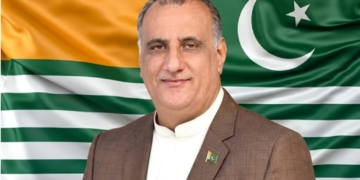
Senator Amir Waliduddin Chishti, Chairman of the Senate Standing Committee on National Health Services, Regulations and Coordination, stated that officials from the Ministry of Health and the Drug Regulatory Authority of Pakistan (DRAP) briefed the committee that a cumulative increase of 32 percent has been recorded since the deregulation of nonessential medicines by the caretaker government.
He further shared that prices of some drugs have doubled, registering a 100 percent increase, while many others have undergone a price hike of around 50 percent, putting additional financial strain on the public.
According to Senator Chishti, the primary objective behind deregulation was to foster healthy competition in the market, attract new investment, and support export growth within the pharmaceutical sector. The policy was never intended to place an excessive financial burden on consumers who are already struggling due to economic challenges.
Decision to Seek Clarification from the Industry
Senator Chishti explained that a 32 percent cumulative increase over two years indicates the need for corrective intervention. He said that pharmaceutical companies whose medicine prices have risen by 50 percent or more will be formally asked to justify these increases.
He added that the committee plans to hold a meeting with representatives of pharmaceutical companies next month, and if any evidence is found indicating collusion, cartelization, or coordinated price manipulation, the matter will be forwarded to the Competition Commission of Pakistan for further investigation and action.
He further emphasized that the committee does not wish to harm the pharmaceutical industry, but expects the sector to grow without transferring the cost of its expansion onto patients who are already under financial pressure.
Senator Chishti also mentioned that the committee is waiting for recommendations from the Prime Minister regarding the pricing of nonessential medicines, after which additional decisions will be made.
Before deregulation, companies were permitted to increase prices by up to seven percent annually in accordance with the Consumer Price Index (CPI). Based on this formula, the total increase over two years should not have exceeded fourteen percent. However, after deregulation, this rise escalated to thirty-two percent.
Claims Rejected
Meanwhile, the Pakistan Pharmaceutical Manufacturers Association (PPMA) has rejected the government’s claim that medicine prices jumped abnormally. According to the association, their assessment indicates that the average increase was closer to fifteen percent, and if the rise attributed to new products and variations in strength—around three percent—is removed, the actual increase over the past two years is approximately twelve percent.
PPMA representative Tauqeer-ul-Haq stated that deregulation was a timely and necessary step, which prevented the possible collapse of the pharmaceutical industry amid rising production costs, continuous currency depreciation, inflation, increasing labor and energy expenses and heavy taxation.
He added that this policy made medicines available again that had previously disappeared from the market, improved overall supply and significantly reduced the circulation of counterfeit products.
The pharmaceutical sector maintains that the old controlled-pricing mechanism had become unsustainable, because under that system, any price revision—no matter how small—required approval from the federal cabinet, which was often withheld or delayed due to political considerations.
A manufacturer explained that whenever a proposal for price adjustment was submitted, it was commonly rejected by the cabinet due to political pressures. Therefore, the industry believes that deregulation could only be implemented during the caretaker government.
Although prices did increase as a result of the policy, the persistent and long-standing shortage of medicines in the market was substantially resolved.
According to Pakistan Chemists and Druggists Association Chairman Abdul Samad Budhani, deregulation improved the availability of medicines and helped eliminate chronic supply shortages.
He described deregulation as an unavoidable step, noting that it freed the sector from rigid central price control, which had long restricted the industry’s ability to adjust prices in line with rapidly rising production costs.
However, he pointed out that some essential medicines, often referred to as “hardship cases,” still face difficulties. He added that the real relief was needed for these vital medicines, but their price adjustments were delayed or rejected due to bureaucratic procedures, while increases for nonessential medicines were approved, leading to shortages of several important drugs.