































































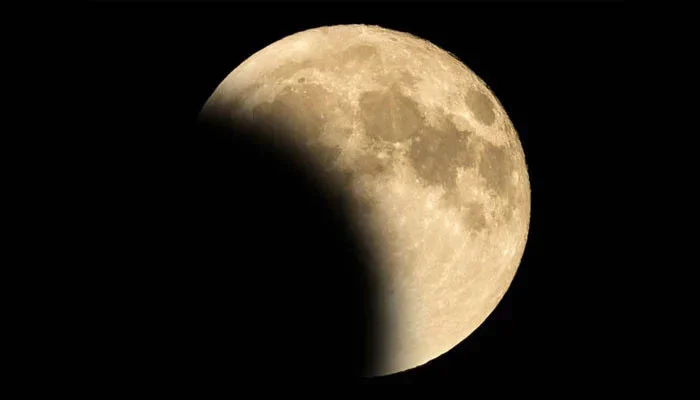
The Meteorological Department has announced that the first total lunar eclipse of the year will take place on March 3, during which the Moon will appear reddish as it moves into the Earth’s shadow. According to experts, this astronomical phenomenon is commonly referred to as a “Blood Moon.”
This will be the first total lunar eclipse of 2026, occurring when the Earth comes directly between the Sun and the Moon, causing the Moon to be fully covered by the Earth’s shadow and take on a red or orange hue. Astronomers describe the event as scientifically significant and visually striking.
In Pakistan, the eclipse will begin at 1:44 pm, while the partial phase will start at 2:50 pm. The total lunar eclipse will occur at 4:05 pm and reach its peak at 4:34 pm.
The ending phase will begin at 5:03 pm, and the eclipse will completely conclude at 7:23 pm. The phenomenon will be clearly visible in Australia, North and South America, and several other regions of the world. In Pakistan, however, it will only be partially visible due to daylight conditions.
Experts explain that a total lunar eclipse occurs when the Earth’s shadow completely covers the Moon, blocking direct sunlight. However, some sunlight passing through the Earth’s atmosphere bends and casts a red or orange glow on the Moon, giving rise to the term “Blood Moon.”
Astronomers have clarified that the Moon’s reddish appearance is a purely natural astronomical process and is not linked to any unusual or dangerous changes.