






















































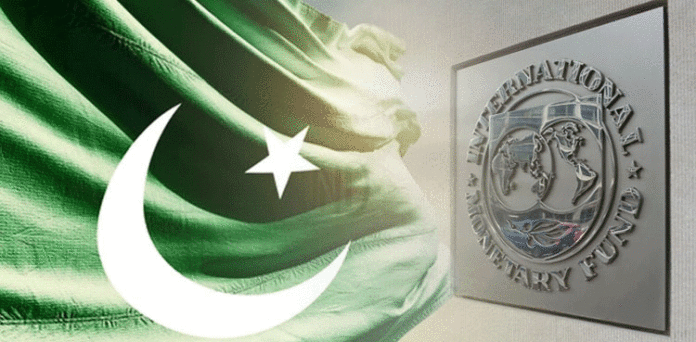
Islamabad: A staff-level agreement has been reached between the International Monetary Fund and Pakistan, under which the country will gain access to financial support following formal approval.
According to the IMF, after final approval, Pakistan will receive $1 billion under the Extended Fund Facility and up to $210 million under the Resilience and Sustainability Facility, bringing the total to $1.2 billion. The funds will be released after approval by the IMF Executive Board, and with the new tranche, the total disbursement to Pakistan will reach $4.5 billion.
The IMF stated that Pakistan’s economy is showing signs of improvement, with inflation and the current account deficit under control. However, tensions in the Middle East pose potential risks to the economy.
The statement noted that the Government of Pakistan remains committed to reducing the fiscal deficit, with ongoing reforms aimed at improving the tax system. The Benazir Income Support Program has been expanded to support low-income groups, and additional financial assistance has been planned to mitigate the impact of inflation.
The IMF stated that the State Bank will maintain a tight monetary policy to control inflation, and interest rates may be increased further if required.
According to the Fund, foreign exchange reserves have increased and overall economic stability has improved, although fluctuations in energy prices could contribute to rising inflation.
The IMF emphasized the need for Pakistan to expand its tax base and control expenditures, noting that early results of FBR reforms have started to emerge. Pakistan is working to strengthen digital invoicing and tax audit systems, while the Tax Policy Office is preparing a medium-term reform strategy. Efforts are also underway to ensure a fair and balanced distribution of the fiscal burden between the federal and provincial governments.
A primary surplus target of 1.6 percent has been set for fiscal year 2026, with plans to increase it to 2 percent by fiscal year 2027. The government has decided to increase spending on health, education, and social protection, while poverty reduction remains a key priority. Targeted assistance for inflation-affected segments is also being continued.
The statement added that Pakistan has assured the stability of its banking system for external payments and reaffirmed its commitment to reforms in the energy sector, including measures to curb circular debt.
The IMF noted that reforms and privatization of state-owned enterprises remain key priorities, while the government has indicated a reduction in market intervention. Efforts to combat corruption and promote investment are also ongoing.
Measures to address climate change will be accelerated, with a focus on promoting green transport and reducing carbon emissions. Work is also underway to improve water systems and strengthen financial preparedness for disasters, while energy sector reforms continue in line with climate targets.